Guaranteed Human
Hope for the church in a digital and disenchanted age


Greetings from Falls Church, Virginia. I’m here teaching a Truett Seminary D.Min. cohort for the week, and I’m thoroughly enjoying my time with Virginia Baptists. Until somewhat recently, I wasn’t aware that the Baptist General Convention of Texas (BGCT, sometimes also known as Texas Baptists) and the Baptist General Association of Virginia (BGAV, Virginia Baptists) had a close relationship. Both state associations hold a similar position of being theologically “moderate,” most commonly meaning that they support women in ministry. Since my institution—Truett Seminary—is a proponent of training women for ministry, it makes sense that Truett would have a relationship with the BGAV in addition to the BGCT.
Virginia Baptists also hold the unique distinction of being a state convention that predates any of the national conventions of Baptists. The BGAV is older than the Southern Baptist Convention, the American Baptist Convention, and the like.
One of my students this week is serving in a church that is almost as old as the United States. Even better? The previous church he pastored was even older.
I mention this, because several of my students are serving in churches that could be termed as “historic.” And, as you may have heard, historic churches have fallen on hard times. Most of them are either plateaued or declining in attendance, giving, and other measurable metrics. Sociologist of religion, Ryan Burge, recently declared that most every American Christian denomination is disproportionately dependent upon Baby Boomers in both attendance and giving. His stark warning:
“For every 100 Silent/Boomers in the Episcopal Church there are only 60 Gen X/Millennials to replace them.
In the United Methodist Church, it’s 100 -> 63.
For the Southern Baptists, it’s 100 -> 86.”
In another place, he was even clearer: “No one is ready.”
As you might imagine, the conversation surrounding church decline is front and center in our discussion this week. It’s looming in most every pastoral circle.
And so the question arises: What should we do to fight decline? There’s no one single answer to that question, but I’ll push back against the common prevailing wisdom.
Most pastors and church leaders think that the first thing a church should do to fight decline is to simply increase activity. Makes sense, right? If we simply do more, then we will attract more people. And, to be fair, sometimes this can work—at least if the goal is to get more people into the building on a Sunday morning. There’s no doubt that increased activity can increase opportunities to engage, visit, and evangelize.
But it may be more complex than that.
My co-teacher this week is Josh Hayden. Josh recently (2025) wrote what I believe to be the best book I have ever read for church leaders hoping to bring new life into a their congregations: Remissioning Church.
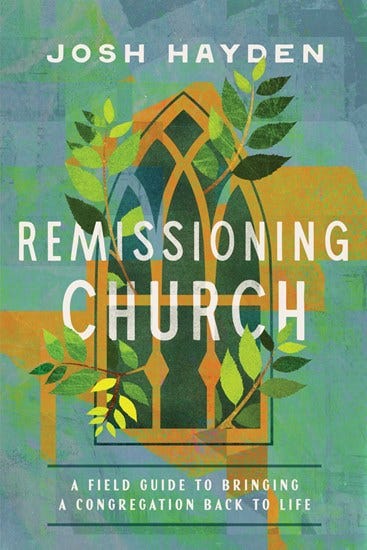
Josh points out that the initial impulse for churches is to do more, but it might be best to first listen. He challenges pastors to talk to their congregation and—perhaps even more surprisingly—to listen to their community. He encourages pastors and leaders to get into public spaces, knock on doors, post QR codes in coffee shops…to get into community spaces where they can ask thoughtful questions and then listen to the responses of their neighbors.
His thinking: If churches want to reach their neighbors, they need to know what is happening with their neighbors. And while churches usually think they know what’s happening in their surrounding area, there is almost always at least some level of disconnect.
It kept coming up this week: Connect and listen to people.
And I suspect it will keep coming up.
I know there is a great deal of doom and gloom that is rightfully placed regarding the church, but let me tell you why I’m actually optimistic:
We’re reaching the human threshold.
I was recently listening to a podcast that touted their podcasts were recorded by an actual human being. They used the slogan, “Guaranteed Human,” in fact.
Why? Well, because computers are taking over. AI is everywhere. And I mean everywhere. If you’re like me, you’ve been fooled at least once by now by a video that looks genuine but is actually AI generated. I called my pharmacy (CVS) the other day and was “served” by an AI chatbot. It was a terrible experience. I’d describe it as fingernails on a chalkboard. I couldn’t wait to connect with an actual person. Just a week before I had a similar experience with American Airlines and their online AI bot. I was thrilled to call customer service and speak to a human. Their human agent understood my problem and promptly helped me. The AI bot? I might as well have been screaming into the Abyss.
Can computers do some cool things? You bet. But there’s still something beautiful (and far more helpful) about connecting to a person.
I’m reminded of church during the COVID shutdown. It was nice to watch church from my couch—for about two weeks. Then I wanted to be with people again. I grew tired of Zoom meetings even more quickly. It didn’t take long for me to remember why we are an embodied and incarnational people—we crave physical presence.
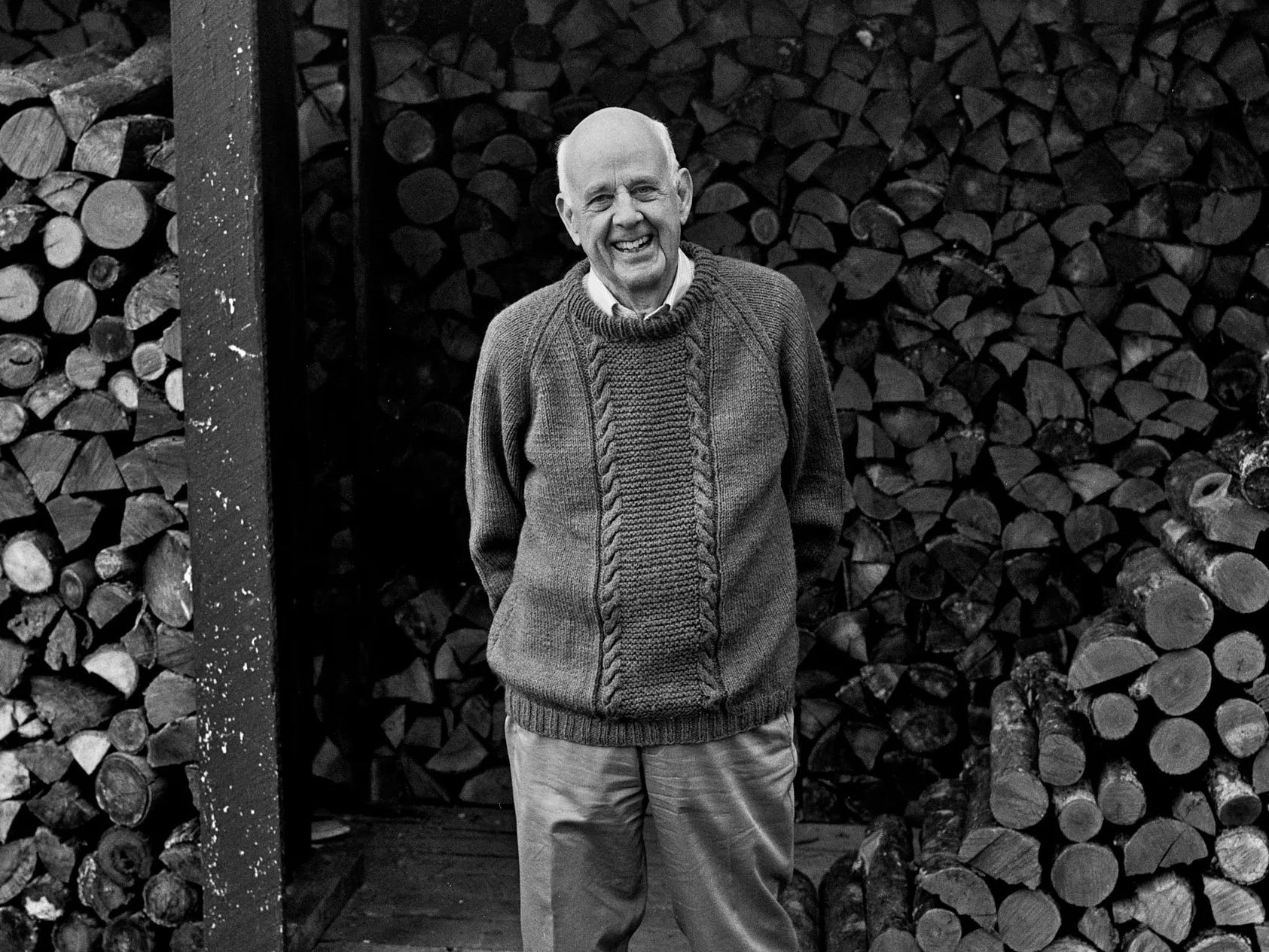
In his book, Life is a Miracle, Wendell Berry says, “It is easy for me to imagine that the next great division of the world will be between people who wish to live as creatures and people who wish to live as machines.”
I have no doubt there will be some who fully embrace AI, who yearn for the Convergence, when their brains are uploaded to the Cloud.
Count me out.
I want to soak up being human. I want to experience the love, thrill, pain, joy, loss, taste, yearning, and grief all the way down to the dregs. I want to wring every bit life has to offer out of this mortal coil, and I want to do it with other people who also want to relish being human beings.
Which is why I’m optimistic about the church—it’s where humans can be human.
I recently read a piece in the New York Times explaining why potlucks need to make a comeback. The writer traveled to a small town in Vermont to see a community potluck dinner firsthand, with real neighbors feeding real food to real people. The writer wistfully explains: “People are increasingly siloed by professional or political affiliation, but relationships with physical neighbors are still important.”
I couldn’t agree more. And great news: Churches never stopped doing potlucks.
At the end of the day, I think spaces where people get to be with people—to be Guaranteed Human with one another will become more special.
But beyond that: As technology takes on more of what we do, it will become even more rare to find spaces with Guaranteed Humans partaking of things that are mysterious. The Canadian philosopher, Charles Taylor, pointed out that we live in a dis-enchanted time—a secular age. There is very little space for things like the spiritual.
But what about a space where prayer is centered? Where a transcendent God is worshipped? Where the Body and Blood are partaken? Where we still dare to believe in (and experience) things that are beyond that which might be replicated by bits and bytes? Theologian Andrew Root has exhorted us: Dare to wait on God.

A space like that—where people are human and where we wait on God—might become something beautiful again.
I’ll be honest: The church has its problems. It has sold its soul for political power too many times. It has doubled down on culture wars too often instead of loving those across the street. It has chosen pragmatism over beauty and usefulness over that which is good more times than I want to admit.
And yet.
If the church can rediscover grace, if the church can rediscover loving one another, if the church can set aside the pursuit of political power and instead find peace with the power of ordinary service, it can rediscover its extraordinary superpower—one another.
In the God who became man, we can gather around the Table, sing a hymn, read the Psalms, and remember what makes us the only creature created in the image of God.
Together, if we dare to listen and love, we might once again discover what it means to be a Guaranteed Human.
Amen, Steve!!
Great article, Steve! I’m glad that you are addressing the issues of AI as they affect our faith. In the technical world I’ve been working on the issues of AI since the early 1980’s - one of the previous periods of “AI hype.”